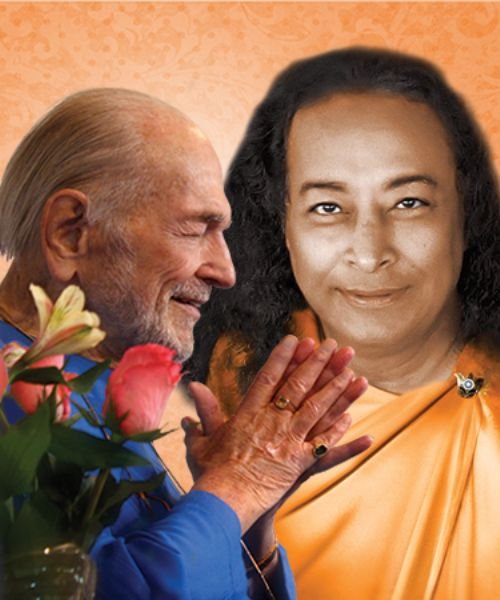
The opening sentence of Autobiography of a Yogi by Paramhansa Yogananda reads: “The characteristic features of Indian culture have long been a search for ultimate verities and the concomitant disciple-guru relationship.”
This magnificent book goes on to explain and inspire with countless spiritual teachings and insights, but it purposefully starts with this simple statement about truth and discipleship. The greatest spiritual books, teachers, and inspirations will always come up short without discipleship to a true Guru who is one with God.
Swami Kriyananda understood this, despite his search for truth taking him everywhere else—until he read that book and immediately sought discipleship at the feet of Paramhansa Yogananda this very week in 1948. From that point on, Swamiji spent sixty-five years deepening his discipleship and attunement to the Guru, tirelessly spreading his teachings and work. From the very beginning, even as he traveled cross-country to meet Yogananda, he knew the true twofold purpose of life: to find God and share Him with everyone.
The present age of energy, or Dwapara Yuga, is characterized by a growing awareness of energy as the underlying force behind all matter, including the human form. Although this manifests in endless distracting ways, like social media and AI, in the disciple-guru relationship it opens new vistas for expressing truth. Swamiji exemplified this perhaps more than any modern disciple: through music, writing, communities, lecturing, transforming education and the arts, renunciation, and much more. Every single creative work was an expression of discipleship.
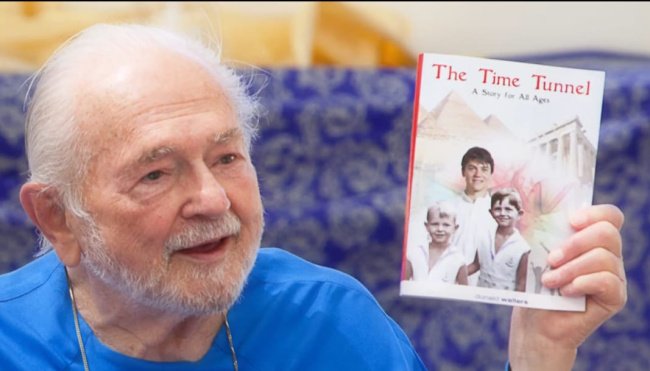
One lesser-known book Swamiji wrote was a children’s fantasy that nevertheless contains deep teachings about the ancient cycles of time, or Yugas, including fascinating and fun adventures through ancient civilizations and mystical times. Oddly enough, when he wrote this book, Swamiji thought that I should pose on the cover as one of the main characters, Hansel! Despite this being a fun adventure of my own, I was pleased when later editions of the book featured a cover without my youthful face front and center.
Although a super volcano of creative energy and attunement, Swamiji remained fluid in his discipleship. He never claimed to know Master’s will (if anyone did it was him!), nor harbored assumptions or expectations of others. He lived in the moment and shared his wisdom and joy spontaneously according to his circumstances. His greatest desire for others was to help them, as disciples or simply as souls, express the highest version of their own true Self. If his help wasn’t welcome, he simply and humbly offered a silent blessing to all.
Swamiji once playfully said, “To thine own funky self be true,” meaning we all get to specialize in being ourselves. Discipleship means we get to play that same fun and sometimes funky role, aspiring nonetheless to be true to our own highest Self.
Ultimately, the Guru is guiding every single disciple to that highest Self, in every aspect of life, including and especially through every difficulty. This help is always available, but requires listening and willingness. When a disciple asked the great saint Anandamayi Ma why it was so hard to do this, Ma simply replied, “Shall I listen to you, or do you want to listen to me?”
Another great saint, Sister Gyanamata, took a similar no-nonsense approach to discipleship: “We must do what is right, whether we feel like it or not. Let the little self whine if it will.”
When we listen to the Guru, to God, and to the higher Self—which ultimately are one and the same—and respond with willingness, the path to discipleship becomes much simpler.
A man once came to see Yogananda, who was in a wheelchair at the time. They hadn’t met, but the omniscient Master knew why he had come. Gesturing to his wheelchair, he said to the man, “Come, you take me in my wheelchair, and I’ll take your soul to heaven.”
This is discipleship in its highest expression: we serve the Guru willingly and lovingly, and he makes our soul free in God.
Discipleship requires cooperation with other disciples, especially senior disciples and those appointed to help lead the Guru’s work. It requires serving the Guru, even in the humblest of ways. And it requires a dedicated practice of “deeper, longer, thirsty, guru-given meditation,” to the best of one’s ability, to prepare the soul for its union with Spirit.
Discipleship is all of these things, and yet it can’t be learned from a book. It can’t be limited to a few, and it can’t be limited to any form. In this lifetime, Dwapara discipleship is an endless creative expression of these principles in action.