That brilliant four-word sentence, written by author Ann Lamott, captures for me the wisdom and joy of good humor. Philosophy doesn’t get more profound than that.
More than twenty years ago, when I was managing Ananda’s East West Bookshop in California, authors and presenters would often approach me, hoping to be added to our calendar of lectures and workshops. One of my most memorable encounters was with an Indian gentleman who said he was a practitioner of “Laughter Yoga.” I was intrigued, and I arranged an interview. When the man entered the store, he walked up to me without saying a word, reached out to shake my hand and didn’t let go. His face lit up, and what followed was more than 30 seconds of his non-stop, top of his voice, uninhibited laughter. I signed him for a workshop on the spot, which we repeated several times over the years. It was a huge success, because genuine laughter is irresistible as a means to lift our spirits, as a source of good health and healing, and even as a rejuvenating aerobic exercise.
Paramhansa Yogananda advised reading something humorous every day, to be even-minded and cheerful even in the face of personal trials, and to cultivate a light-hearted attitude no matter how difficult the people and circumstances around us. No one was a better model of these ideals than Swami Kriyananda. He loved a good laugh. Swamiji would punctuate his lectures with humorous stories that were also instructive, and he would laugh with unaffected amusement at his own follies. Once, when giving a lecture, a cell phone started ringing. He had previously asked that phones be put on silence, and when the ringing continued, he paused and asked again with a slight hint of annoyance. A moment later, reaching into his pocket, he realized the offending phone was his own! No one laughed more genuinely than he did.
Good humor today has largely been replaced by jokes with a cutting edge that puts people down. Is that really funny? Humor can be witty and speak the truth, but when condescending, it furthers an us vs. them mentality, which is plainly divisive. On the other hand, there is much about our world that needs reforming, and pointing this out with humor can be both funny and effective. Gandhi once answered a reporter’s question with a wry and poignant remark that was also delightfully humorous. The reporter asked him, “Sir, what do you think of Western civilization?” Gandhi replied, “I think it would be a good idea!”
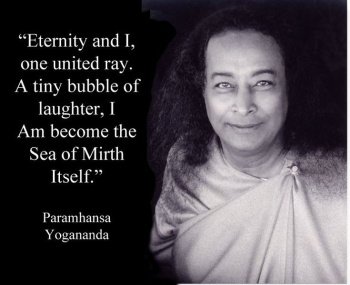
Where does humor fit in the greater scheme of life and spirituality? Is it really so important? Yogananda spoke of cheerfulness as a fundamental aspect of our path to God. In his classic poem Samadhi, he described a vast universe of cosmic events: past, present and future, all transmuted into a realm “beyond imagination of expectancy,” and he ended with this magnificent sentence: “Eternity and I, one united ray, a tiny bubble of laughter, I am become the Sea of Mirth Itself.”